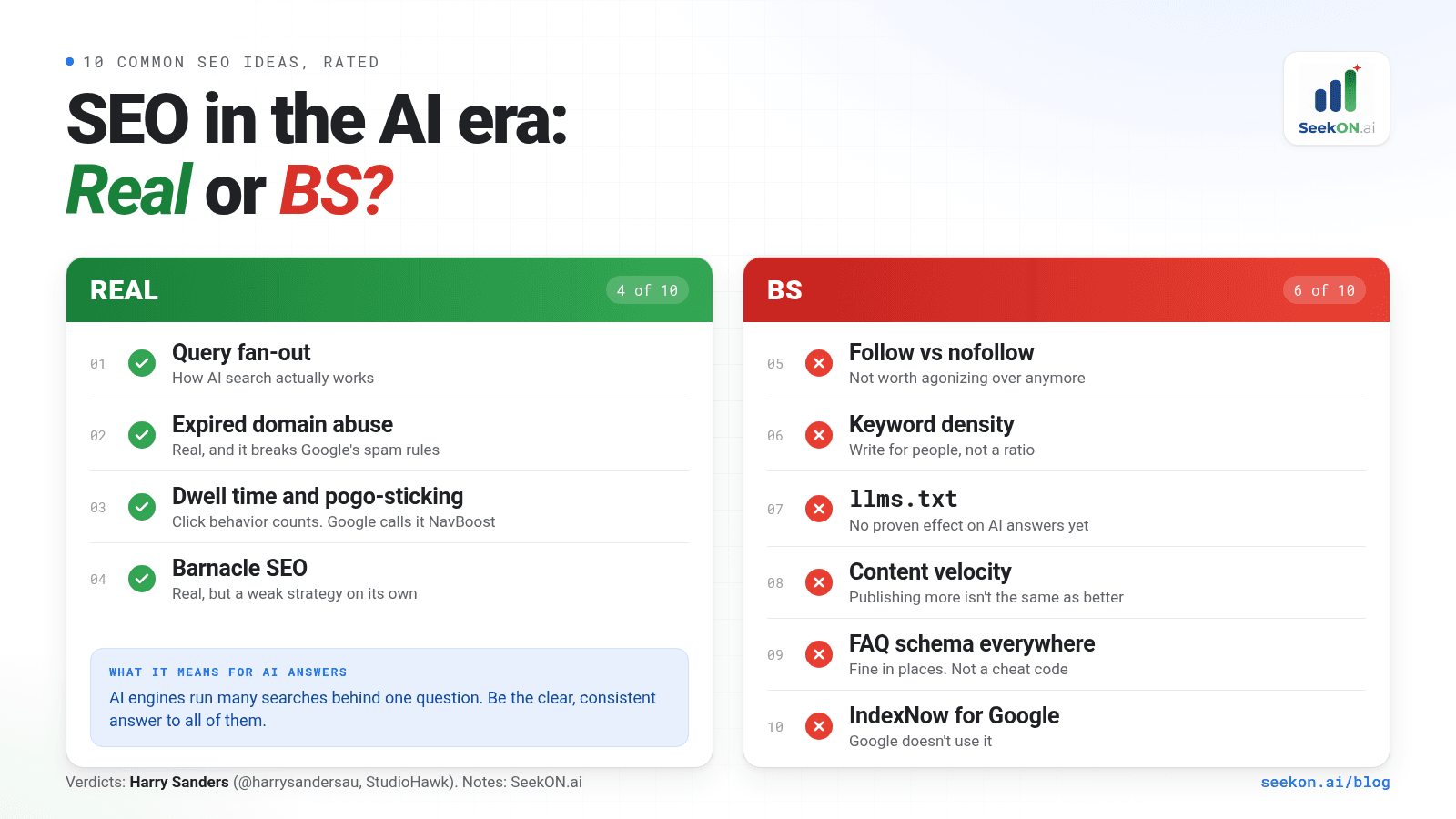
Harry Sanders founded StudioHawk, a Melbourne SEO agency, and in October he posted a 34-second YouTube Short with a title that doesn't mess around: "a lot of the SEO advice you've heard is either outdated or was never true to begin with." He reads out ten common SEO ideas and gives each one a snap verdict. Four are real. Six are BS.
We liked it. It's fast and mostly right. A one-word verdict doesn't tell you what to do on Monday morning, though, and a few of these ideas change shape once you care about being named in ChatGPT, Claude, Gemini and Google's AI answers, not only the blue links. So we took his board and wrote up every item: what it is, why the verdict holds (or where we'd push back), and what it means for showing up in AI answers.
Watch Harry's Short here. The verdicts are his. The explanations, and any disagreements, are ours.
| # | Idea | Verdict | The short version |
|---|---|---|---|
| 1 | Query fan-out | Real | This is how AI search builds an answer |
| 2 | Expired domain abuse | Real | People do it, and it's against Google's spam rules |
| 3 | Dwell time and pogo-sticking | Real | Click behavior counts. Google calls the system NavBoost |
| 4 | Barnacle SEO | Real | Works, but a weak plan on its own |
| 5 | Follow vs nofollow | BS | Not worth agonizing over anymore |
| 6 | Keyword density | BS | Write for people, not a ratio |
| 7 | llms.txt | BS | No proven effect on AI answers yet |
| 8 | Content velocity | BS | Publishing more isn't the same as publishing better |
| 9 | FAQ schema everywhere | BS | Fine in the right places, not a cheat code |
| 10 | IndexNow for Google | BS | Google doesn't use it |
1. Query fan-out: real
When you ask an AI search tool a question, it usually doesn't run your exact words as a single search. It splits the question into smaller ones, runs those at the same time, and stitches the results into one answer. Google calls this query fan-out, and it's documented for both AI Overviews and AI Mode. Google's own AI optimization guide uses a lawn example: someone asks "how to fix a lawn that's full of weeds," and the system might also search "best herbicides for lawns," "remove weeds without chemicals," and "how to prevent weeds in lawn."
Harry's verdict: "that's how AI search works." He's right, and it's the most useful item on the board.
For a business, that means you aren't competing for one keyword anymore. You're competing to be the best source for a cluster of related questions the model asks on your customer's behalf. Picture two plumbers. One has a page that says "We install water heaters." The other's page also covers what a tankless unit costs to install, how long the job takes, which brands they service and whether they handle permits. When someone asks an AI assistant about replacing a water heater, the second plumber has an answer for every sub-question the engine goes looking for.
Don't overcorrect. That same Google guide warns that creating separate pages for every fan-out variation, mainly to manipulate rankings or AI responses, falls under its scaled content abuse policy. One strong page that answers the real follow-up questions will beat twenty thin ones.
Fan-out is also the reason a Seekon audit doesn't check one ranking and call it a day. It runs the keywords your customers actually type as live prompts across ChatGPT, Claude and Gemini, then shows who gets named. The engines assemble answers from several searches, so the honest way to measure your visibility is to ask the way a customer would.
2. Expired domain abuse: real
The tactic goes like this: buy a domain that used to belong to a respected site, keep its backlinks and history, then fill it with unrelated, low-value content and hope the old reputation carries it. Google's example, from its March 2024 announcement, was a former medical site repurposed to host casino content.
Harry says it's real because people do it. They do. It's also spam by Google's definition. Google named expired domain abuse as a spam policy in March 2024, next to scaled content abuse and site reputation abuse, and in May 2026 it updated its documentation to make clear that its spam policies apply to generative AI responses in Search too (Search Central changelog).
One clarification so nobody panics: buying an old domain isn't the problem. Google says it's fine to use an old domain for a new, original site built for people. Moving your business to a better domain is normal.
For AI visibility, it's a bad bet even before you count the penalty risk. AI engines describe a business based on what the web says about it. A domain with years of history about something unrelated hands the model mixed signals about who you are. What you want is the opposite: the same name, services and location on your site and everywhere else you're listed.
3. Dwell time and pogo-sticking: real
Dwell time is how long someone stays on your page after clicking through from search. Pogo-sticking is when they click, bounce straight back to the results, and try someone else. SEOs argued for years about whether Google pays attention to any of this.
Harry says real, and he names the system: NavBoost. Here's what's actually on the public record. In the 2023 US v. Google antitrust trial, Google's Pandu Nayak testified that NavBoost uses past click data for queries, going back about 13 months. Notes from a 2025 call with Nayak, filed as a trial exhibit, describe it as a query-to-document table of click counts. And in 2024, leaked internal Google API documentation, reported by Rand Fishkin of SparkToro and Mike King of iPullRank, included NavBoost fields named goodClicks, badClicks and lastLongestClicks.
Where we'd add nuance: Google has never confirmed "dwell time" as a metric by that name, and nobody outside Google knows how much weight these signals carry. So don't chase a seconds-on-page number. The useful takeaway is simpler: if people click your result and go right back to find a better one, that's a bad sign, and Google has ways of noticing.
AI engines aren't watching your bounce rate, but the fix is the same for both. Put the answer near the top of the page in plain words, then add the detail. A page that satisfies a person in ten seconds is also a page a model can quote without guessing.
4. Barnacle SEO: real, but a bad strategy
Barnacle SEO means attaching yourself to a big site that already ranks (Yelp, a major industry directory, Reddit, YouTube, a "best of" roundup) instead of trying to outrank it with your own site. Harry agrees it's real. He just thinks it's a bad strategy.
As your main plan, we agree. You don't own those pages. A platform can change its rules, its layout or its own rankings and take your visibility with it overnight.
This is where we'd add the most nuance on the whole list. We think third-party presence matters more for AI answers than it ever did for classic SEO, and Google's AI optimization guide says its generative AI features "can show what's being said about products and services across the web, including in blogs, videos, and forum discussions." A business that only exists on its own website gives an AI engine one source to go on, and that source is you talking about yourself.
So don't make barnacles your whole strategy, and don't skip them either. Keep your Google Business Profile complete. Make sure your listings on the two or three directories that matter in your industry are accurate. Earn real reviews. The same guide says chasing inauthentic mentions "isn't as helpful as it might seem," so skip anyone selling bulk mentions. When an AI engine gets your hours or services wrong, the culprit is sometimes an old listing on a site you forgot existed, which is one of the things the accuracy section of a Seekon report helps you track down.
5. Follow vs nofollow: BS
A rel="nofollow" attribute on a link tells search engines not to pass ranking credit through it. For years SEOs treated nofollow links as worthless and obsessed over their ratio of followed to nofollowed links.
Harry: "BS, not anymore. Not important." The history backs him up. In 2019 Google changed nofollow from a rule to a hint and added two new attributes, rel="sponsored" and rel="ugc". Google now decides for itself how much to count those links.
One piece still matters, though. If you pay for a link, or get one as part of a sponsorship, Google wants it marked sponsored or nofollow. Skip that and you risk a link scheme action. "Not important" applies to fretting over the mix of links you earn. It doesn't apply to labeling the ones you paid for.
For AI visibility the attribute matters even less. If a respected local news site or an industry roundup mentions your business, a model reading that page sees your name either way. Spend the time earning mentions on sites your customers trust, and stop auditing rel attributes.
6. Keyword density: BS
The old rule of thumb said your target keyword should make up a set percentage of the page, with numbers like 1 to 3 percent floating around forums for years. Google never published a number like that. What it does publish is a spam policy against keyword stuffing.
Harry called it "absolutely not important," and AI search makes it even less relevant. Google's AI guide says its systems understand synonyms and general meaning, so you don't need to capture "every variation of how someone might seek content like yours." Language models work with meaning, not word counts. Writing "best HVAC company in Dallas" five times in one paragraph reads as spam to a person and adds nothing for a model.
Use the words your customers actually use, naturally, in the page title and early in the copy. Then spend your effort on specifics: the neighborhoods you serve, the brands you work on, typical price ranges, how fast you can show up. Specifics are what get quoted.
7. llms.txt: BS (for now)
llms.txt is a Markdown file you put at the root of your site to give AI systems a curated summary of your business and links to your most useful pages. Jeremy Howard of Answer.AI proposed it in September 2024, and it has had a lot of buzz since.
Harry's advice was "don't worry about that." Google agrees, in writing. Its AI optimization guide says Google Search ignores llms.txt files, and that creating one "will neither harm nor help" your visibility in Google Search, though it's fine to keep one for other services that use it. Google's Gary Illyes also said in 2025 that Google doesn't support it and isn't planning to, according to Search Engine Land. As for the other AI companies, we haven't seen OpenAI, Anthropic or Google say their assistants use llms.txt to decide which businesses to cite or recommend. Some site owners have shared logs showing AI crawlers fetching the file, but fetching a file isn't the same as using it to pick an answer.
We'd call it "unproven" rather than BS. Full disclosure: seekon.ai has one. It's cheap to maintain and does no harm. We still wouldn't put it ahead of anything else in this post. If your homepage doesn't clearly say what you do, where you do it and who it's for, a text file in the root folder won't fix that.
8. Content velocity: BS
Content velocity is the idea that publishing on a fast, steady schedule (three posts a week, say) tells search engines your site is active and authoritative. Harry waved it off, and Google is unusually blunt on this one. Its guide to helpful content asks: "Are you adding a lot of new content or removing a lot of older content primarily because you believe it will help your search rankings overall by somehow making your site seem 'fresh?' (No, it won't)." Pump out pages at scale mainly to rank and you also run into the scaled content abuse policy.
Freshness does matter for some topics. If your prices, service area or the rules in your industry change, update the page. That's useful to readers and to any engine trying to give a correct answer. Volume for its own sake is the BS part.
It matters even more for AI answers. Google's AI guide pushes "non-commodity content," meaning content with first-hand experience or a point of view that isn't already everywhere else. Twenty generic posts saying what every other site says give a model nothing new to cite. One post with your real pricing, your actual process, or a job you finished last month gives it something worth quoting. Publish when you have something to say, and keep your important pages current.
9. FAQ schema everywhere: BS
FAQ schema is FAQPage structured data, code that labels the questions and answers on a page. It got popular because Google used to show those questions as expandable dropdowns under your search result, which made your listing bigger. So people pasted it onto every page they had.
That reason is gone. In August 2023 Google limited FAQ rich results to well-known government and health sites, and on May 7, 2026 it stopped showing them in Search altogether, as Search Engine Journal reported.
Harry's verdict is about the "everywhere," and on that we agree. On FAQ schema itself we'd soften it. It isn't useless. It just isn't a cheat code. A real FAQ section that answers the questions your customers ask is good content for people and for AI engines, because short, plain question-and-answer text is easy to understand and easy to quote. Marking that content up accurately is fine. Google says unused structured data doesn't cause problems, and that markup should match what's visible on the page. Google also says there's no special schema you need for its AI features, so the value is mostly in the questions and answers themselves. The markup is a label on top. If you do want to add it, our beginner's guide to schema markup walks through how to do it cleanly.
What doesn't work is bolting the same five generic questions onto every page, or marking up questions that aren't on the page at all. Put an FAQ where customers genuinely have questions, like your pricing page and your main service pages. You'll notice this post has one at the end. It's there because these are questions people ask, on one page, not because we stamp FAQs on everything.
10. IndexNow for Google: BS
IndexNow is an open protocol, launched by Microsoft Bing and Yandex in October 2021, that lets your site ping search engines the moment a page is added, updated or deleted. Participating engines share those pings with each other. The current participant list includes Bing, Yandex, Seznam, Naver, Yep, the Internet Archive and Amazonbot. Google isn't on it.
So Harry's right. Using IndexNow to get Google to notice your pages does nothing. For Google, keep an accurate XML sitemap and use the URL Inspection tool in Search Console when you need a page recrawled.
The protocol itself isn't BS, though. It's a perfectly good way to tell Bing about changes, and Bing matters more than people assume because Microsoft's Copilot draws on it. If your CMS or CDN supports IndexNow (Cloudflare does, through its Crawler Hints feature), turning it on takes a few minutes. Just don't expect it to move anything in Google.
The pattern behind the list
Look at the board again and a pattern shows up. The four "real" items are about how search systems read and judge you: they fan out questions, they watch what searchers do, they punish manipulation, and they listen to what other sites say about you. The six "BS" items are shortcuts that promised to skip that work.
AI search makes the shortcuts even less useful, because the engines are assembling an answer about your business from everything they can find. Here's what we'd do instead, in this order:
- Make your homepage and main service pages say plainly what you do, where, for whom, and roughly what it costs.
- Answer the follow-up questions customers ask on the pages where those questions come up.
- Keep your business name, address, hours and services identical on your site, your Google Business Profile and the few directories that matter in your industry.
- Earn real reviews and real mentions on sites your customers already trust.
- Check what the AI engines actually say about you, then fix the gaps you find.
You can guess at that last step, or you can look. A Seekon audit runs your keywords live across ChatGPT, Claude and Gemini and shows whether you get named, which competitors get named instead, and where the engines get facts about you wrong. The free audit takes a few minutes. If you want the full picture, the Pro Audit is $27, one time, and covers three audits with your own keywords and up to three competitors side by side.
Frequently asked questions
These are the questions we hear most about this topic. One page, real questions, which is the kind of FAQ we'd keep (not "schema everywhere").
Does SEO still matter if people ask ChatGPT instead of Google?
Yes. Google says its AI features are built on its core ranking and quality systems, so normal SEO still decides a lot of what shows up there. Other AI engines also lean on web search and on what other sites say about you. Crawlable pages, clear answers and a consistent reputation help everywhere.
What is query fan-out in plain English?
It's when an AI search tool turns your one question into several smaller searches, runs them at once, and combines the results into a single answer. For a business, it means you need to answer the related questions customers have, not just rank for one phrase.
Should I add an llms.txt file to my site?
It won't hurt, and it takes little time. But Google Search ignores it, and we haven't seen any major AI company say it uses llms.txt to decide whom to recommend. Fix your homepage and service pages first.
Is FAQ schema still worth adding?
On pages that have a real FAQ section, it's fine to add, and it does no harm. Google stopped showing FAQ rich results in 2026, so don't expect a bigger listing, and don't paste the same FAQ markup on every page. The questions and answers themselves are what matter.
How can I check whether AI engines recommend my business?
Ask them the way a customer would, across more than one engine, and note who gets named. Our guide on how to check if ChatGPT recommends your business has copy-paste prompts, or a Seekon audit will run the test live across ChatGPT, Claude and Gemini for you.
Inspired by Harry Sanders' YouTube Short "a lot of the SEO advice you've heard is either outdated or was never true to begin with" (@harrysandersau). The verdicts are his; the commentary is Seekon's.
See what AI engines say about your business
Run your keywords across ChatGPT, Claude and Gemini and see whether you get named, who gets named instead, and where the engines get your facts wrong.
Run My Free AI Visibility Check